NEWS
·
December 15, 2025
Building the Future of AI Together
A friendly thought

7 min read

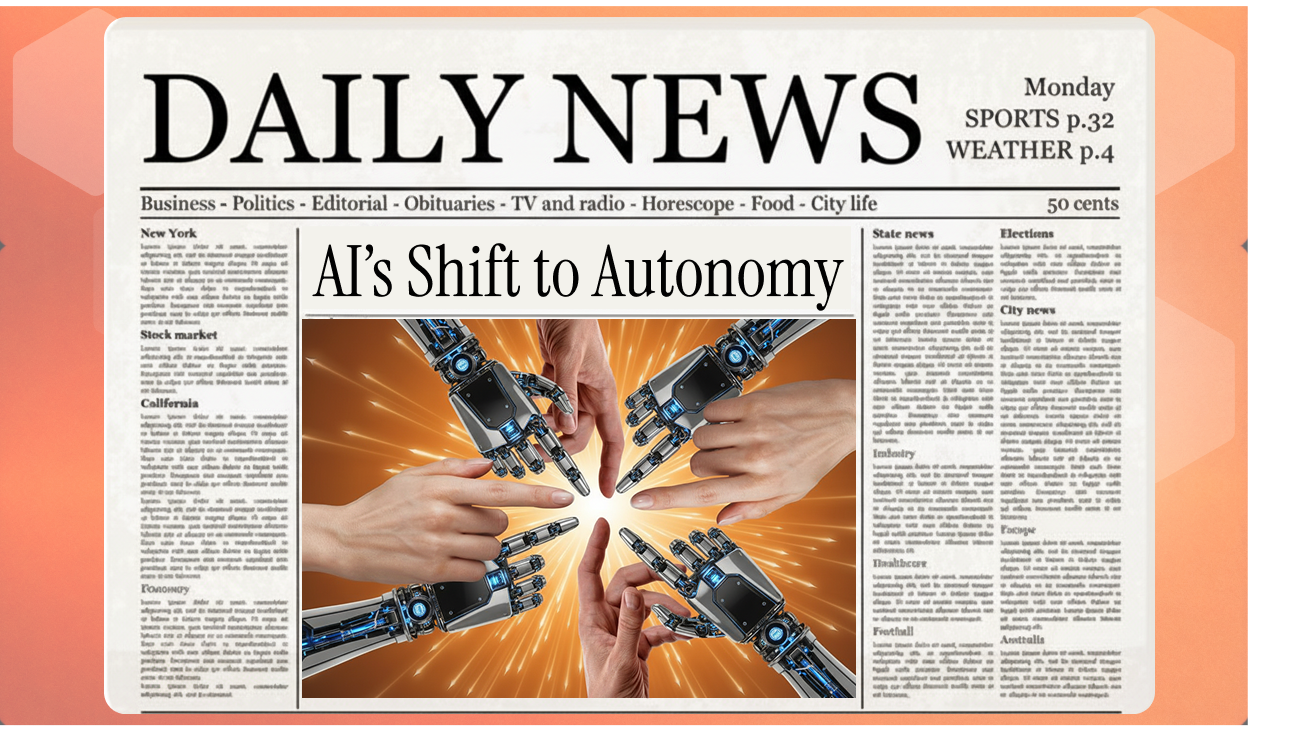
Generative AI's experimental phase is concluding, making way for truly autonomous systems in 2026 that act rather than merely summarize.
2026 will lose the focus on model parameters and be about agency, energy efficiency, and the ability to navigate complex industrial environments. The next twelve months represent a departure from chatbots toward autonomous systems executing workflows with minimal oversight, forcing organizations to rethink infrastructure, governance, and talent management.
While 2025 was defined by experimentation, the coming year marks a decisive pivot towards agentic AI—autonomous software entities capable of reasoning, planning, and executing complex workflows without constant human intervention.
Telecommunications and heavy industry are becoming the proving grounds. The trajectory points toward autonomous network operations, moving beyond simple automation to self-configuring and self-healing systems. The business goal is to reverse commoditization by prioritizing intelligence over pure infrastructure and reducing operating expenditures.
Technologically, service providers are deploying multiagent systems. Rather than relying on a single model, these allow distinct agents to collaborate on multi-step tasks, handling complex interactions autonomously. However, increased autonomy introduces new threats.
As AI agents gain the ability to autonomously execute tasks, hidden instructions embedded in images and workflows become potential attack vectors. Security priorities must therefore shift from endpoint protection to governing and auditing autonomous AI actions.
As organizations scale these autonomous AI workloads, they hit a physical wall: power.
Energy availability, rather than model access, will determine which startups and platforms scale. Compute scarcity is now a function of grid capacity, suggesting energy policy will become the de facto AI policy globally.
Key performance indicators must adapt. Enterprises will prioritize energy efficiency as a primary metric. The new competitive edge won't come from the largest models, but from the most intelligent, efficient use of resources.
Horizontal copilots lacking domain expertise or proprietary data will fail ROI tests as buyers measure real productivity. The clearest enterprise ROI will emerge from manufacturing, logistics, and advanced engineering—sectors where AI integrates into high-value workflows rather than consumer-facing interfaces.
Platforms like Definable AI that integrate multiple models and tools into unified workflows are positioning themselves to meet these efficiency demands, allowing organizations to optimize resource usage while maintaining access to cutting-edge capabilities.
Software consumption is changing fundamentally. The traditional concept of an "app" is becoming fluid. In 2026, AI will start to radically change the way we think about apps, how they function and how they're built.
Users will soon request temporary modules generated by code and a prompt, effectively replacing dedicated applications. Once that function has served its purpose, it closes. These "disposable" apps can be built and rebuilt in seconds.
Rigorous governance is required here. Organizations need visibility into the reasoning processes used to create these modules to ensure errors are corrected safely.
Data storage faces a similar transformation, especially as AI becomes more autonomous. The era of digital hoarding is ending as storage capacity hits its limit.
AI-generated data will become disposable, created and refreshed on demand rather than stored indefinitely. Verified, human-generated data will rise in value while synthetic content is discarded.
Specialist AI governance agents will pick up the slack. These digital colleagues will continuously monitor and secure data, allowing humans to govern the governance rather than enforcing individual rules. For example, a security agent could automatically adjust access permissions as new data enters the environment without human intervention.
Sovereignty remains a pressing concern for global IT operations. Enterprise leaders increasingly view open-source solutions as vital for achieving data sovereignty. Service providers will leverage existing data center footprints to offer sovereign AI solutions, ensuring data remains within specific jurisdictions to meet compliance demands.
Competitive advantage is moving from owning models to controlling training pipelines and energy supply. Open-source advancements are allowing more actors to run frontier-scale workloads, democratizing access to powerful AI capabilities.
Workforce integration is becoming more nuanced and personal. Tools ignoring human factors—tone, temperament, and personality—will soon feel obsolete. By 2026, predictions suggest that half of workplace conflict will be flagged by AI before managers know it exists.
These systems will focus on communication, influence, trust, motivation, and conflict resolution. Personality science will become the operating system for the next generation of autonomous AI, offering grounded understanding of human individuality rather than generic recommendations.
AI platforms that understand context and personality, integrating seamlessly with how people actually work, will differentiate themselves from those offering one-size-fits-all solutions.
The era of the thin wrapper is over. Buyers are now measuring real productivity, exposing tools built on hype rather than proprietary data or genuine innovation. For enterprises, competitive advantage will no longer come from simply renting access to a model, but from controlling the training pipelines, energy supply, and integrated workflows that power meaningful business outcomes.
Platforms that offer comprehensive ecosystems—combining multi-model access, autonomous agents, knowledge integration, and workflow automation—will be better positioned than single-purpose tools. The value lies not in access to one AI model, but in orchestrating multiple capabilities into cohesive, productive systems.
The shift to autonomous AI in 2026 requires organizations to prepare across multiple dimensions:
Infrastructure: Moving from static applications to dynamic, AI-generated modules requires flexible, scalable systems that can handle rapid creation and disposal of software components.
Governance: As AI becomes more autonomous, governance frameworks must evolve from rule enforcement to meta-governance—governing the systems that govern themselves.
Energy Management: Power consumption becomes a strategic consideration. Organizations must factor energy efficiency into their AI deployment strategies, not just as a cost issue but as a competitive differentiator.
Human Integration: Success requires understanding that AI augments human work, not replaces it. Tools that account for personality, communication styles, and workplace dynamics will outperform those that treat humans as interchangeable units.
Data Strategy: The distinction between valuable human-generated data and disposable synthetic data requires new approaches to data management, storage, and valuation.
2026 represents a maturation point for AI technology. The experimental phase of generative AI gave us powerful tools for creation and summarization. The next phase brings genuine autonomy—systems that reason, plan, and execute with minimal human oversight.
This transition challenges existing assumptions about software, data, infrastructure, and work itself. Organizations that recognize these shifts early and adapt their strategies accordingly will be positioned to capture the full value of autonomous AI. Those that continue treating AI as a chatbot or simple automation tool will find themselves increasingly behind.
The question for 2026 is not whether AI will become autonomous, but how quickly organizations can adapt to a world where software acts independently, data becomes disposable, and energy efficiency determines competitive advantage.
The future of AI is autonomous. The future of work is collaborative. And the future of competitive advantage lies in intelligent orchestration of both.
The AI revolution of 2026 won't be about better models—it will be about smarter systems that act autonomously while integrating seamlessly with human work. Are you ready?