Knowledge base
·
December 12, 2025
How to Organize Your Knowledge Base in Definable AI
7 min read

6 min read


The point of technology is to make life better for people. We call it innovation, but it's just the constant process of asking how to make things better. Bullying, on the other hand, is when large corporations use legal threats and intimidation to block innovation and make life worse for people.
This week, we've seen aggressive tactics from major platforms demanding that AI companies prohibit users from using their AI assistants on these platforms. This represents a fundamental threat to all internet users and their right to choose their own tools.
For the last 50 years, software has been a tool, like a wrench in the hands of the user. But with the rise of agentic AI, software is also becoming labor: an assistant, an employee, an agent.
The law is clear that large corporations have no right to stop you from owning wrenches. Today, some platforms are announcing they do not believe in your right to hire labor, to have an assistant or an employee acting on your behalf. This isn't a reasonable legal position, it's a bully tactic to scare disruptive companies like Definable AI out of making life better for people.
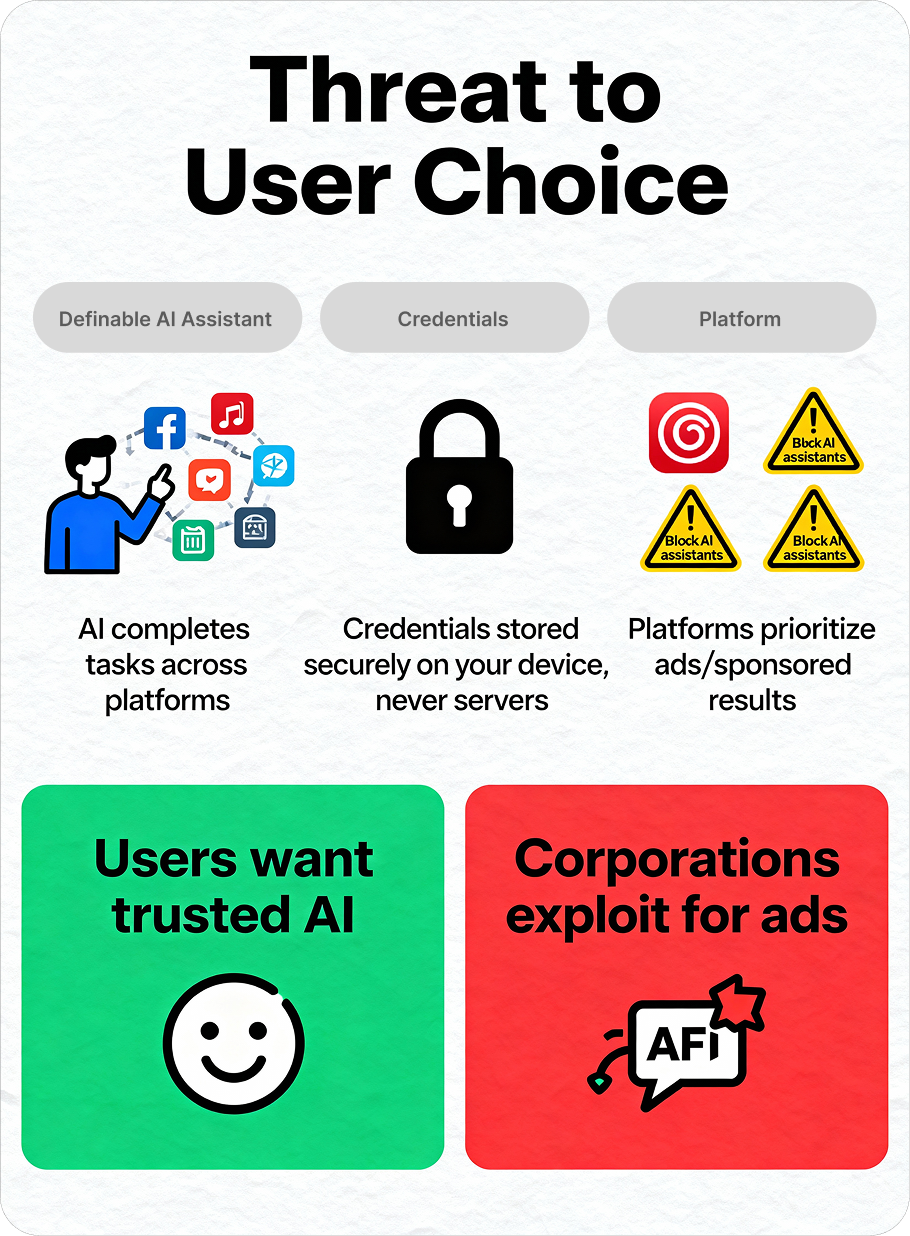
Major platforms want to block you from using your own AI assistant to interact with their services. Here's what they're trying to prevent: You ask your Definable AI Assistant to find and complete tasks across different platforms. If you're logged in to these platforms (credentials in Definable AI are stored securely only on your device, never on our servers), your AI Assistant quickly completes tasks for you, saving you time for more important activities. You can ask it to compare options, analyze information, and execute actions based on your preferences. Definable AI users love this experience.
These platforms should love this too. Easier interactions mean more transactions and happier customers. But they don't care. They're more interested in serving you ads, sponsored results, and influencing your decisions with upsells and confusing offers.
Large corporations want to eliminate user rights so they can sell more ads right now and partner with AI agents designed to take advantage of users later. It's not just bullying, it's bonkers.
Every platform should celebrate creating delightful customer experiences. But it's dangerous to confuse consumer experience with consumer exploitation. Users want AI they can trust, and they want AI Assistants that work on their behalf and no one else's.
User agents are exactly that: agents of the user. They're distinct from crawlers, scrapers, or bots. A user agent is your AI assistant—it has exactly the same permissions you have, works only at your specific request, and acts solely on your behalf.
Assistive AI is becoming an increasingly important aspect of the global economy, businesses everywhere, and the individual rights and capabilities of every person. We believe it's crucial to raise awareness about the issues facing user agents.
For user agents to serve their true purpose, they must be:
Your AI assistant must be indistinguishable from you. When Definable AI Assistant visits a website, it does so with your credentials, your permissions, and your rights. (It's also unable to do anything you can't). Publishers and corporations have no right to discriminate against users based on which AI they've chosen to represent them. Users must have the right to choose technologies that represent them. Privacy and freedom of choice depend on this.
Your user agent works for you, not for Definable AI, and certainly not for large corporations. For decades, machine learning and algorithms have been weapons in the hands of large corporations, deployed to serve ads and manipulate what you see, experience, and purchase. The transformative promise of modern AI is that it puts power back in the hands of people. Agentic AI marks a meaningful shift: users can finally regain control of their online experiences.
Your AI assistant must be capable of any task that matters to you. Users have a right to select high-performing AI agents from the cutting edge of innovation. The technology available to users can't be hamstrung just because it threatens some public company's pressure to deliver more ad revenue. The future of AI, like all technology, is for people.
The rise of agentic AI presents a choice. Will this technology empower users to take control of their digital lives? Or will it become another tool for corporations to manipulate and exploit?
Definable AI is fighting for the rights of users. People love our products because they're designed for people. User choice and freedom are at the heart of everything we build.
Perhaps that's what makes us a target for corporate bullies. But these corporations shouldn't forget what it's like to be innovative and passionate about world-changing products. They too once faced intimidating threats and fought aggressively to give users better choices.
These platforms also forget how they got so big. Users love them. They want good products, seamless experiences, and efficient results. Agentic AI is the natural evolution of this promise, and people already demand it. Definable AI demands the right to offer it.
We believe in three fundamental principles:
Users own their data and their digital presence. No corporation has the right to dictate which tools you use to interact with the internet.
AI should serve users, not advertisers. Your AI assistant works for you alone, prioritizing your needs over corporate interests.
Innovation benefits everyone. Technologies that make life easier shouldn't be blocked simply because they threaten established business models.
The battle over user agents isn't just about technology—it's about who controls the future of the internet. Will it be users, empowered by AI assistants that work on their behalf? Or will it be corporations, using legal threats to maintain monopolies on user attention and manipulation?
Definable AI stands with users. We build tools that put you in control. We believe your AI assistant should serve you, not corporations.
This isn't just about one platform or one feature. It's about establishing the fundamental right of every internet user to choose the tools that represent them online.
The future of AI belongs to people, not platforms.
And we'll fight to keep it that way.