Knowledge base
·
December 12, 2025
How to Organize Your Knowledge Base in Definable AI
7 min read
6 min read


2025 was said to be the year that AI agent technology went mainstream. Today we are announcing Definable AI researchers have published the first large-scale study of how people actually use AI agents in the real world.
Our researchers asked three fundamental questions: Who is adopting AI agents? How intensively are they using them? And what tasks are they delegating to their AI assistants? By analyzing hundreds of millions of anonymized interactions from Definable AI Agent users, we've uncovered fundamental patterns about agent adoption and usage.
The findings challenge some common narratives. For instance, agents are good at booking hotels or handling rote chores, but they're also serving as partners in deep cognitive work. They are reshaping how we learn, work, and solve problems.
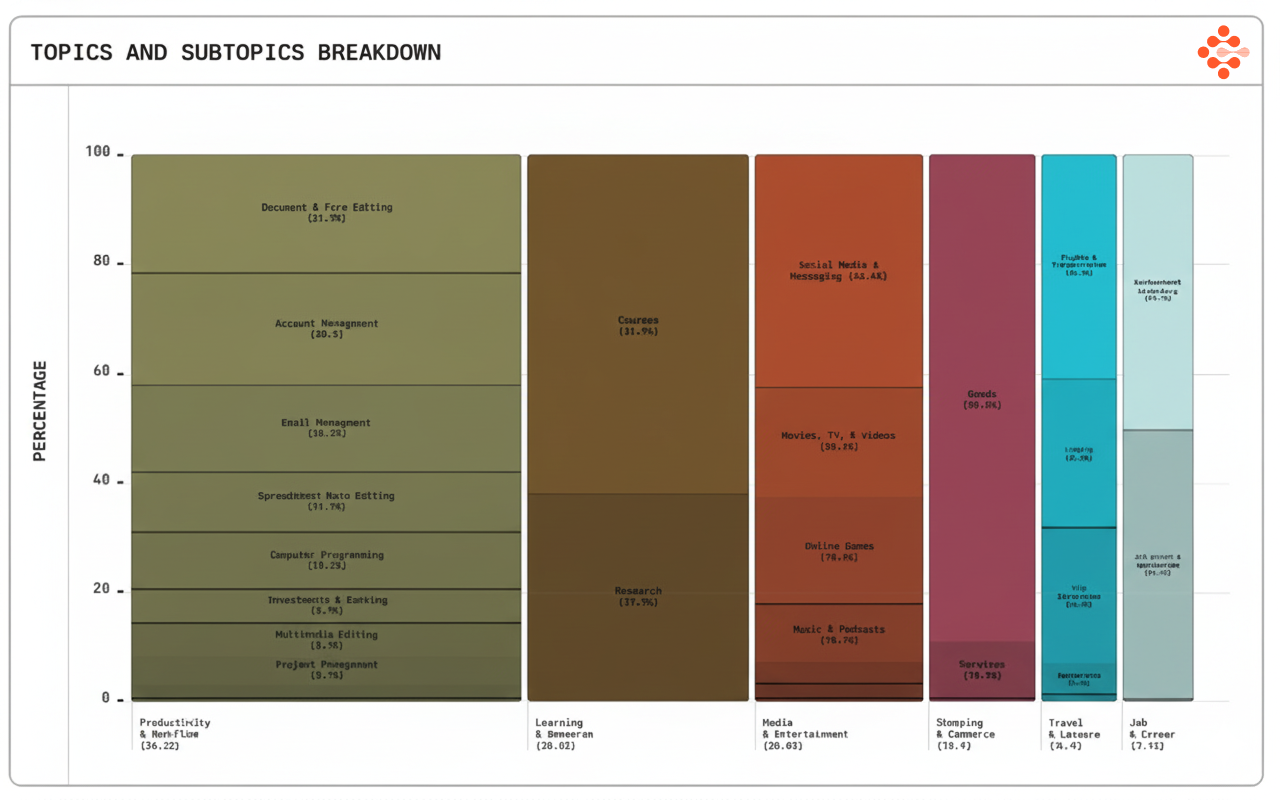
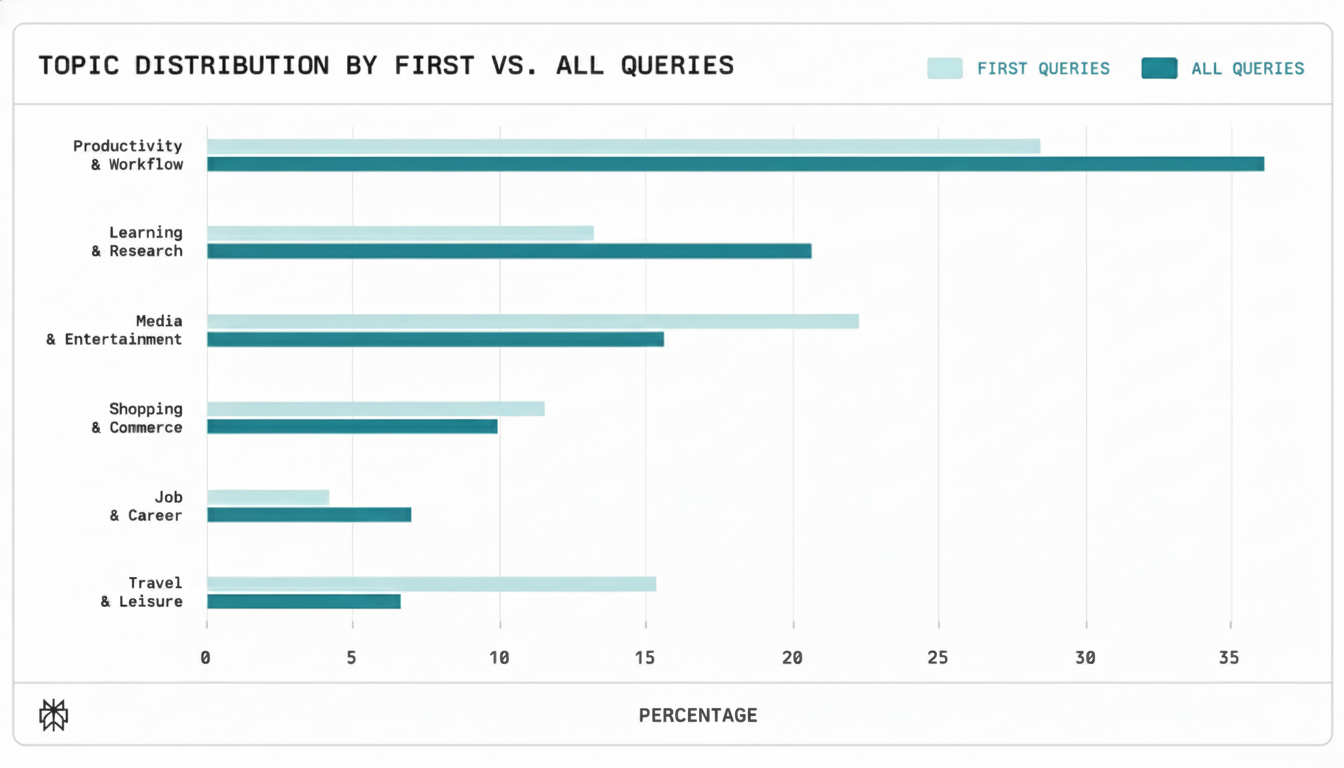
A popular vision of AI agents is the "digital concierge" use case, in which humans offload simple tasks to save time. Yet, when we classified millions of user interactions, we found that 57% of all agent activity focuses on cognitive work. Thirty-six percent of the most common tasks are classified as productivity and workflow tasks, with another 21% classified as learning and research.
These are tasks that scale human capability. A procurement professional used Definable AI Agents to scan customer case studies and identify relevant use cases before working with a vendor. A student asked the agent to navigate through course materials and analyze what they were learning. A finance worker delegated the tasks of filtering stock options and analyzing investment information. In each case, the agent handled information gathering and initial synthesis autonomously, giving the user the information they needed to make final judgments and decisions, and implementing those decisions at their request.
The "thinking partner" use case supported by our data shows that users want to expand their ability to do hard stuff. People aren't using Definable AI Agents to avoid work, they're using it to do better work.
One of the most revealing patterns in the study is the journey of the user. How you use an agent on Day 1 is rarely how you use it on Day 100.
New users often test the waters with low-stakes queries. They ask about travel plans, movie recommendations, or general trivia. Gradually, there's a shift. Our analysis of query transitions shows a strong gravitational pull toward productivity. A user might start by asking about a vacation spot, but once they use the agent to debug a Python script or summarize a financial report, they rarely go back. The productivity and workflow categories have the highest retention rates, and users who engage in learning or research tasks early on are much more likely to become long-term active users.
This mirrors the early days of the personal computer. It was often sold as a tool for recipe management or games, but it became indispensable because of spreadsheets and word processing. AI agents are following the same trajectory.
The most telling metric isn't who adopts AI agents, but who relies on them. The gap between adoption rates and usage intensity reveals where the technology has shifted from a novelty to a necessity. Narrow gaps indicate genuine behavioral change, and six core occupations now drive 70% of all agent activity.
Certain sectors punch above their weight. While digital technologists naturally lead volume (30% of queries), knowledge-intensive fields like Marketing, Sales, Management, and Entrepreneurship, demonstrate the highest "stickiness." Once these professionals adopt an agent, their usage intensity outpaces their adoption numbers as they integrate the assistant into their daily workflow.
Context also matters. Users deploy Definable AI Agents to solve the specific friction points of their industry. Finance professionals are heavily focused on efficiency, dedicating 47% of queries to productivity tasks. Students are focused on utility, with 43% of tasks allocated to learning and research. In design and hospitality, it's even easier to see how context-specific usage dominates, from media work for designers to travel planning for hospitality staff.
Ultimately, the data proves Definable AI Agents are highly versatile and reflect the specific needs of each user. In an educational context, they serve as specialized research engines while in a professional context, they become multi-purpose assistants. Personal contexts account for over half of all query volume.

This study provides the first empirical proof that we are moving toward a hybrid intelligence economy. The dominance of cognitive tasks in our data suggests that AI agents are scaling human cognitive work. As these tools mature, we expect the "stickiness" of productivity tasks to deepen.
As 2025 draws to a close, we're no longer asking if people will use AI agents. We know they are. The question now is how quickly the rest of the economy will adapt to a workforce that thinks, learns, and builds with an intelligent partner always in the loop.
Definable AI: Where Intelligence Meets Action, here